
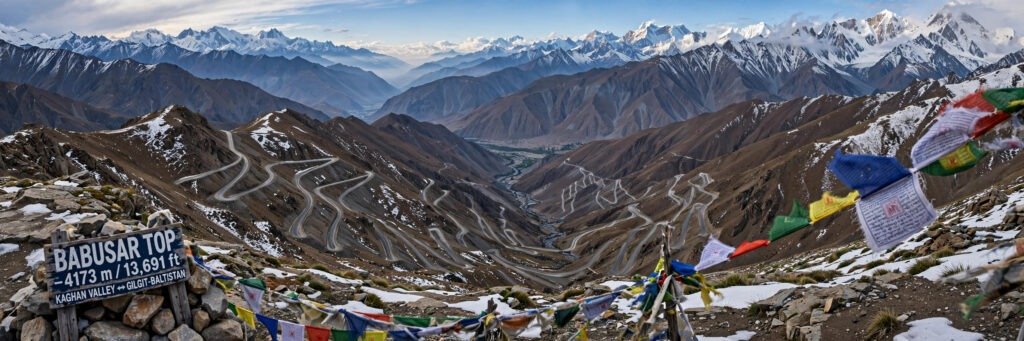
At 4,173 meters (13,691 feet), Babusar Top is the highest point on the Naran–Gilgit road — and one of the most thrilling viewpoints in northern Pakistan. Here’s everything about the route, weather, and timing your visit.
Where Is Babusar Top?
Babusar Top sits on the N-15 between Naran and Chilas, connecting Kaghan Valley to Gilgit-Baltistan. It’s about 70–80 km from Naran town — roughly 2.5–3 hours by jeep/carachievable as a day trip.
The Route from Naran
Naran → Batakundi → Jalkhad → Babusar Top
- The road climbs steadily through alpine meadows
- Last stretch is steep with hairpin bends
- Only high-clearance vehicles and experienced drivers — jeeps are standard
- No fuel stations after Naran — top up before leaving
Best Time to Visit
June to September — and that’s it. The pass is snowbound roughly October–May.
| Month | Status | |—|—| | June | Opens (snow clearance permitting) | | July–August | Prime — fully open, best views | | September | Still good, fewer crowds | | October–May | Closed |
For overall valley timing: Best Time to Visit Naran Kaghan.
Weather at the Top
Mountain weather is dramatic:
- Summer day at top: 5–12°C (while Naran town is 20°C+)
- Wind: Often strong — windchill bites
- Sun: Intense at altitude — sunscreen essential
- Changes fast: Clear morning can turn cloudy by afternoon
Go early. Mornings have the clearest views; clouds build by afternoon.
Altitude: What to Expect
At 4,173 m, the air is thin. Most visitors feel:
- Slight breathlessness on stairs/climbs
- Mild headache if dehydrated
- Everything passes quickly at this altitude for day visitors
Tips: Hydrate, move slowly, avoid heavy meals right before, and descend if you feel genuinely unwell. People with heart/lung conditions should consult their doctor first.
What to Do at the Top
- Photos — the classic “top of the world” shots with the valley spread below
- Chai and pakoras — the dhabas at the top are part of the experience
- Prayer flags and viewpoints — short walks around the summit area
- Snow patches — even in July, you’ll find snow to play in
Most visitors spend 1–2 hours at the top.
Combining with Your Naran Tour
Babusar Top fits naturally into:
- 3-day Naran itinerary — Day 2
- Naran tour from Karachi — 5-day plan
- Naran tour from Islamabad — 3-day plan
What to Pack for the Day Trip
- Warm jacket (even in August)
- Sunscreen, sunglasses, cap
- Water and snacks
- Power bank (cold + altitude drain batteries)
- Cash for dhabas and small shops
FAQs
Is Babusar Top open now?
It’s seasonal (June–September). Check current status before planning — contact us.
Can cars reach Babusar Top?
High-clearance vehicles with experienced drivers. Most tours use jeeps/4x4s for the top section.
Is it safe for kids?
The altitude is fine for short visits; the road is the main concern — go with experienced drivers.
How long should I spend at the top?
1–2 hours is plenty for photos, chai, and the views.
What’s beyond Babusar Top?
The road descends to Chilas and onward to Gilgit and Hunza — it’s the gateway to Gilgit-Baltistan.
Do I need a jeep for Babusar Top?
Not always, but a jeep is the safer choice early in the season when the upper road is rough. Later in the season, cars with good ground clearance also reach the top. Ask your driver about the day’s road condition before choosing.
Is there mobile signal at Babusar Top?
Signal at the pass is unreliable and varies by network. Download offline maps and inform your hotel of your plan before departing, so you are not dependent on signal at the top.
Can I visit Babusar Top in one day from Naran?
Yes. Babusar Top is a standard day trip from Naran: leave early in the morning, spend time at the top, and return to Naran the same day with daylight to spare.
Is Babusar Top crowded in peak season?
Yes, midday in peak season is busy with day-trip traffic. Visit early in the morning for quieter roads and better light, and avoid weekends if your dates are flexible.
Is Babusar Top open in October?
Usually yes in early October, but it depends on snow. The pass closes when early winter snow arrives, sometimes in late October, so confirm pass status before planning a late-season visit.
Babusar Top Photography: Capturing the Pass
Babusar Top rewards photographers with wide panoramas of peaks, valleys and the winding road below, but mountain light changes fast. Early morning usually gives the clearest air and softest light, while midday sun can be harsh on snow and rock. Clouds gather quickly at the pass, so shoot the wide views first and details later. Keep your camera and phone batteries warm in an inside pocket, because cold and altitude drain batteries faster. If you are travelling by jeep, ask the driver for a few extra minutes at the best viewpoints — the pass is a stop, not a destination to rush through, and the best photographs come from patience, not speed.
Think in layers when you frame a shot: a foreground stone, a ribbon of road, and a ridge behind it will give a flat panorama depth that a single wide view often lacks. Walk a short way from the busiest viewpoint and the scene usually opens up, with fewer people in the frame and a cleaner line to the valley below. Try both wide and close views, because a detail — a fluttering flag, a patch of late snow, a bend in the road — can say more about the pass than another sweep of peaks. Take a spare memory card if you have one, keep lenses clean in the wind, and review your first few shots on the spot, while you still have time to try again.
Photography also rewards a relaxed itinerary, rather than a day packed with stops in every direction. When Babusar is part of a longer stay, you can linger at the pass without worrying about everything else that still has to fit into the day, and you can return to Naran with a set of pictures that actually reflects the place. If you are still shaping your trip, browsing Naran Kaghan tour packages can help you see how a Babusar day fits alongside lakes, meadows and valley viewpoints, so the pass becomes a highlight of the journey instead of a hurried detour on the way to somewhere else.
Road Conditions and Jeep vs Car
The road from Naran to Babusar Top climbs steeply and its condition varies through the season. Early in the season, melting snow and water crossings make the upper road rough, and jeeps handle it more comfortably than ordinary cars. Later in the season, when the road is drier, cars with good ground clearance also make the trip, but low cars still risk scraping. Local drivers know the day’s condition best, so ask your driver or hotel before choosing a vehicle. Whichever vehicle you use, travel in daylight and allow extra time for the climb, because the mountain road rewards slow, careful driving and punishes rushing.
It also helps to think about comfort, not just whether a vehicle can reach the top. A rough upper section can feel very different for passengers than it does for the driver, especially on a climb with a loose surface and tight turns. Keep bags secure, sit where you feel steadiest, and expect a slow, bumpy stretch rather than a smooth drive. If anyone in your group is uneasy on mountain roads, say so before you set off, so the driver can choose a steady pace and suitable stops. A calm, unhurried climb is safer and far more enjoyable than trying to make up time on a road that was never built for speed.
Planning the vehicle as part of the whole trip, rather than as a last-minute choice in Naran, usually works better. When your transport, driver and overnight stops are settled in advance, the Babusar day can be shaped around the weather and the road on the day, instead of around whatever happens to be available that morning. A 5 days Naran Kaghan tour is one way to build that breathing room into the journey, giving you time for the pass, for rest, and for the valley itself, without turning the day into a race against the light.
Food and Facilities at the Top
Facilities at Babusar Top are basic and seasonal. A few small stalls sell tea, snacks and simple food during the open season, but they are not guaranteed on any given day, and prices and availability vary. Carry water, snacks and any medicines you need from Naran, and do not plan to depend on buying a full meal at the top. There are basic toilet facilities near the pass, but they are limited, so use facilities in Naran before departing. Families with children should carry extra snacks and water, because the high altitude and cold increase thirst and hunger, especially for kids.
Packing a small food bag the evening before also saves a lot of fuss on the morning of the trip. Sandwiches, fruit, dry snacks and a refillable bottle are easy to carry, share well in a jeep, and mean you are not hungry while you wait for a stall to open or for the group to regroup. Keep anything that melts or spoils easily out of direct sun, and carry a small bag for wrappers, because the pass looks its best when visitors leave nothing behind. A little preparation here is really about comfort: you can enjoy the views, rather than spending the stop searching for food.
Families and larger groups often find it easier to treat Babusar as a planned stop within a wider domestic tour, where meals, rest and driving are already thought through for the day. That way, the basic facilities at the top are a bonus — a hot cup of tea if a stall is open — rather than something the whole day depends on. Check with your driver or host about where to stop for a proper meal on the way back, and keep the snacks you brought as a backup, not as your only plan for the day.
Sunrise vs Midday at Babusar Top
The time of day changes Babusar Top completely. Early morning brings quiet roads, clear air and golden light on the peaks, and is the best time for photography and for travellers who dislike crowds. By midday, the pass is busier with day-trip traffic, the light is harsher, and clouds are more likely to build. Afternoon visits risk weather changes and a rushed return before dark. If your schedule allows, aim for a morning visit: leave Naran early, reach the top before the crowds, and return with daylight to spare. A morning Babusar trip feels like a different place from a midday one.
The difference is not only about light. In the morning, the air often feels clearer, the viewpoints are easier to enjoy, and conversations at the pass are unhurried. By the middle of the day, the same viewpoints can feel crowded, with vehicles coming and going and less space to stand back and take the scene in. That is why a morning plan often suits photographers, families with young children, and anyone who prefers a slower pace. You do not need to rush to enjoy it; you simply need to be there before the pass fills up.
A longer valley stay makes a morning visit much easier to arrange, because you are not trying to fit the pass, a lake and a meadow into a single crowded day. With more time, you can choose the clearest morning, rest properly the night before, and return to Naran without feeling pressed. A 7 days Naran Kaghan tour can offer that kind of unhurried rhythm, letting Babusar sit naturally within a week of valley days, rather than as a rushed add-on squeezed between other plans.
Common Mistakes on a Babusar Day Trip
Day trips to Babusar Top go wrong in a few predictable ways. The first is leaving too late, which means reaching the top in cloud or returning in fading light. The second is travelling without warm layers — the top is cold even in summer, and travellers in light clothes cut their visit short. The third is skipping the road-status check: the pass can close temporarily after rain or landslides, and a wasted journey is avoidable with one check. The fourth is overpacking the day — Babusar plus too many other stops leaves no time to enjoy the pass itself. One early start, warm clothes, a status check and a relaxed plan make the day trip work.
Another common slip is forgetting how quickly the weather can turn, even on a bright morning. A jacket left in the hotel because the valley felt warm can become the difference between a comfortable hour at the top and a short, shivering stop. The same goes for sun protection and water: the air feels cool, so thirst and sunburn can creep up unnoticed. Pack as if the top will be colder, windier and brighter than Naran, and you will be ready for the version of the day that actually arrives, not just the one you hoped for.
Finally, resist the urge to promise yourself every viewpoint in the valley on the same day as Babusar. A day trip works best when it has one clear highlight and a relaxed return, with room for a road delay, a longer stop, or a change in the weather. If your heart is set on seeing more of the region, a 10 days Naran Kaghan tour spreads those hopes across several days, so Babusar can be enjoyed on its own terms, and the rest of the valley can wait for a day when you can give it proper attention.
Want to stand at 4,173 m? Explore Pakistan tours or contact us to add Babusar Top to your Naran tour.